
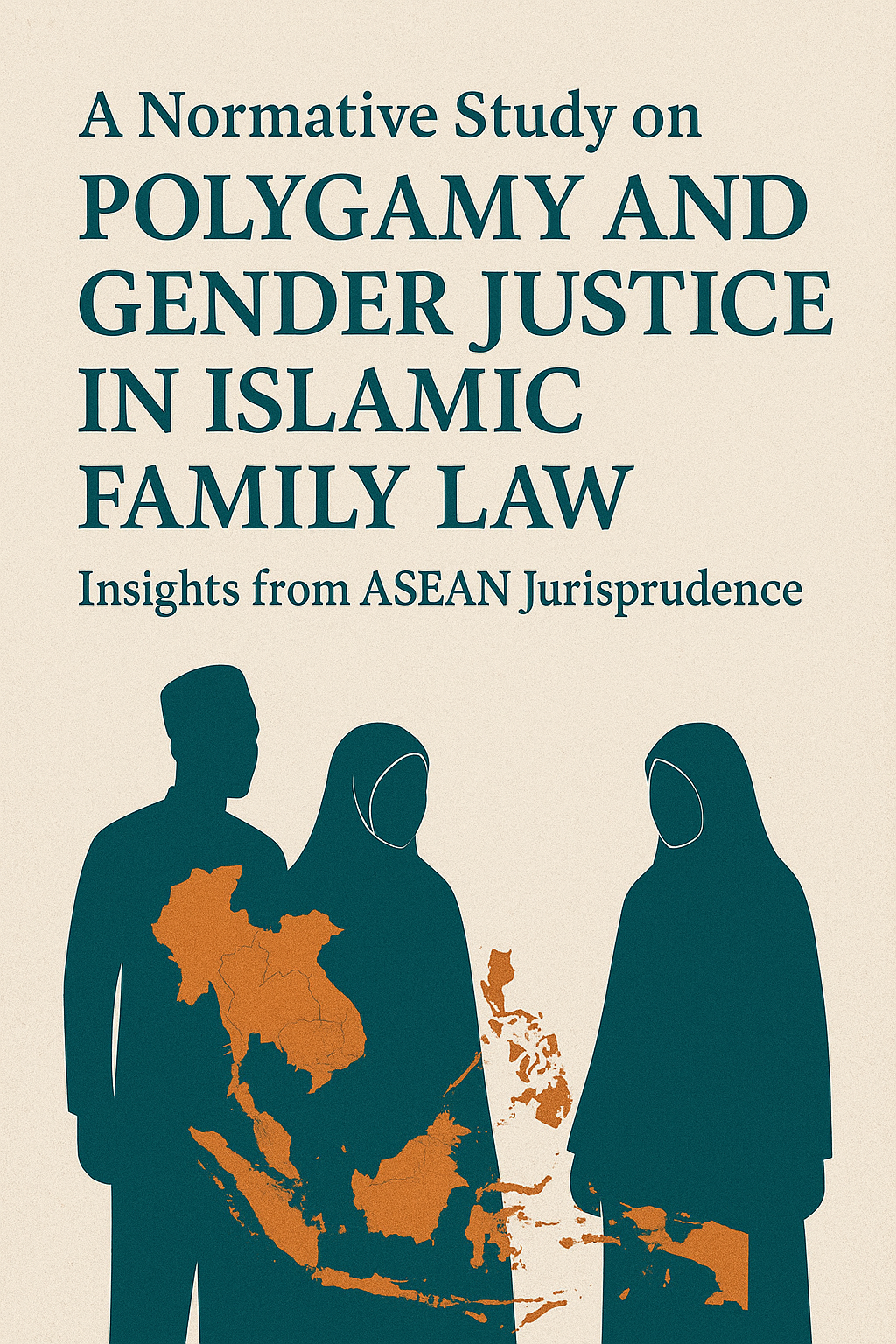
A Normative Study on Polygamy and Gender Justice in Islamic Family Law: Insights from ASEAN Jurisprudence
Article Sidebar
Main Article Content
Abstract
Polygamy (taʿaddud al-zawjāt) in Islamic family law, though classically permitted under specific conditions of justice, presents significant challenges to gender justice in contemporary Muslim societies, particularly in ASEAN. This normative study examines the evolution of polygamy regulation in Indonesia, Malaysia, and Brunei, analyzing the interplay between classical Islamic jurisprudence and modern state legal frameworks. It highlights a critical tension between the permissibility (ibāḥah) of polygamy and the ethical responsibility (ʿadālah) of maintaining absolute justice, often leading to a preference for monogamy in classical interpretations. ASEAN jurisdictions have implemented statutory controls requiring court permission, consent, and financial capacity, aiming for procedural justice. However, the persistence of unauthorized polygamy and critiques from women's rights groups like Sisters in Islam reveal a persistent gap in achieving substantive gender equity. The report argues that a reinterpretation of Islamic family law through the lens of maqāṣid al-sharīʿah (higher objectives of Islamic law) and ijtihād (independent reasoning) offers a robust pathway for crafting gender-responsive interpretations that prioritize dignity, welfare, and fairness for all family members. This comparative analysis of ASEAN jurisprudence underscores the ongoing efforts to balance religious tradition, legal modernity, and constitutional rights in pursuit of a more just and equitable family law system.
Article Details

This work is licensed under a Creative Commons Attribution 4.0 International License.


References
Ade Khoirunnisa, Retno Arimbi Dewi, Fatya Zahra Siahaan, Siti Samra, and Aulil Amri. “Comparison of Islamic Family Law in Malaysia and Indonesia.” An-Nisa: Journal of Islamic Family Law 2, no. 2 (2025): 109–20. https://doi.org/10.63142/an-nisa.v2i2.226.
Affandi, Abdullah, M Mu’tashim Billah, and Muh Syaifudin. “Maqāṣidī Exegesis: A Path for Promoting Gender Equality in Contemporary Islamic Discourse.” QOF 9, no. 1 (2025): 61–80.
Budustour, Leen. “The Role of Islamic Law in Modern Legal Systems in the Arab Region.” Accessed August 4, 2025. https://www.americanbar.org/groups/international_law/resources/newsletters/role-islamic-law-modern-legal-systems-arab-region/.
Chiagozie, Abubaker, and Akpofure Akpofure. “An Analysis of Islamic Law on Polygamy Without Court Permission: Legal, Ethical, and Social Perspectives.” SYARIAT: Akhwal Syaksiyah, Jinayah, Siyasah and Muamalah 1, no. 3 (2024): 156–64. https://doi.org/10.35335/wh2zd103.
Emon, Anver M. “The Paradox of Equality and the Politics of Difference: Gender Equality, Islamic Law, and the Modern Muslim State.” SSRN Electronic Journal, ahead of print, 2011. https://doi.org/10.2139/ssrn.1758966.
“Global Connections . How Many Wives? | PBS.” Accessed August 4, 2025. https://www.pbs.org/wgbh/globalconnections/mideast/educators/women/lesson3a.html.
Halima Ibrahim Bature and Babangida Abba. “The Concept And Ethics Of Polygamy In Islamic Teachings.” International Journal of Education Effectiveness Research, ahead of print, March 31, 2025. https://doi.org/10.70382/hijeer.v06i8.017.
“Islam and the Question of Gender Equality.” Musawah, 2017. https://www.musawah.org/wp-content/uploads/2019/02/KnowledgeBuildingBriefs-3-Islam-and-the-Question-of-Gender-Equality-EN.pdf.
Kamali, Mohammad Hashim. “‘ Maqāṣid Al-Sharī’ah’: The Objectives Of Islamic Law.” Islamic Studies 38, no. 2 (1999): 193–208.
Lee, Sarah. “Islamic Law in Asian Governance.” Accessed August 4, 2025. https://www.numberanalytics.com/blog/islamic-law-asian-governance.
“Malaysia to Study Islamic Polygamy | HeraldNet.Com.” Accessed August 4, 2025. https://www.heraldnet.com/news/malaysia-to-study-islamic-polygamy/.
“Malaysia’s Sisters in Islam (SIS) | Religion and Public Life.” Accessed August 4, 2025. https://rpl.hds.harvard.edu/religion-context/case-studies/gender/malaysias-sisters-islam.
Mir-Hosseini, Ziba. “Towards Gender Equality: Muslim Family Laws and the Shari’ah.” Wanted: Equality and Justice in the Muslim Family, Musawah Petaling Jaya, 2009, 23–63.
Musanna, Khadijatul, Aulia Fitri, Azhar Junaidi, and Akhmad Roja Badruzaman. “Polygamy Legal Politics in Southeast Asian Muslim Countries: Legal Pluralism and Qur’anic Perspectives.” Jurnal Pere 19, no. 2 (2021): 131–47.
Noor, Zanariah. Gender Justice And Islamic Family Law Reform In Malaysia. n.d.
Polygamy In Malaysia. n.d. Accessed August 4, 2025. https://hasrinahakimi.co/polygamy-in-malaysia/.
“Polygyny in Islam - Islam Question & Answer.” Accessed August 4, 2025. https://islamqa.info/en/answers/14022/polygyny-in-islam.
Putra, Herianto, and Desi Anwar. “Muhammad Shahrur’s Perspective on Gender Equality in Inheritance Distribution.” Indonesian Journal of Islamic Law 6, no. 2 (2023): 56–72. https://doi.org/10.35719/ijil.v6i2.2018.
Rashid, Syahirul Syazwan bin. تعدد الزوجات في الإسلام: دراسة ميدانية على المجتمع البروناوي. 2022.
Rifqi, Muhammad Jazil, Nurul Asiya Nadhifah, Mukhammad Nur Hadi, Abdul Basith Junaidy, and Agus Solikin. “Children’s Legal Identity at Stake: Reconstructing Maqasid al-Syari’ah through Marriage Isbat Applications by the Second Generation in Pasuruan.” El-Mashlahah 15, no. 1 (2025): 125–48. https://doi.org/10.23971/el-mashlahah.v15i1.9068.
Roziqin, Opik, and Ah. Fathonih. “The Evolution of Marriage and Inheritance Law in Brunei Darussalam: A Comparative and Historical Study.” Indonesian Journal of Advanced Research 3, no. 11 (2024): 1675–88. https://doi.org/10.55927/ijar.v3i11.12117.
Saidatina, Siti, and Ahdiyatul Hidayah. “The Concept of Justice As A Requirement For Polygamy According To The Imam Syafi’i Mazhab.” Jurnal Al-Fikrah 12, no. 2 (2023): 206–18.
Utami, Puput Putri, Asep Saepullah, and Akhmad Shodikin. “Protection of Women’s Rights in Polygamy in Indonesia.” Journal of Law and Social Politics 1, no. 1 (2023): 1–16.
Widiani, Desti, and Dwiky Bagas Setyawan. “Polygamy in Islamic Family Law in Indonesia (Comparative Study on Law Number 1 of 1974 and the Compilation of Islamic Law).” In Proceedings of the 1st International Seminar on Sharia, Law and Muslim Society (ISSLAMS 2022), edited by Putu Widhi Iswari, Andi Wicaksono, Qosim Khoiri Anwar, Al Farabi, Muhammad Hanif Al Hakim, and Sigit Arif Bowo. Atlantis Press SARL, 2022. https://doi.org/10.2991/978-2-494069-81-7_12.