
Islamic Family Law and Women’s Rights in Indonesia: Between Normativity, Reform, and Social Realities
Article Sidebar
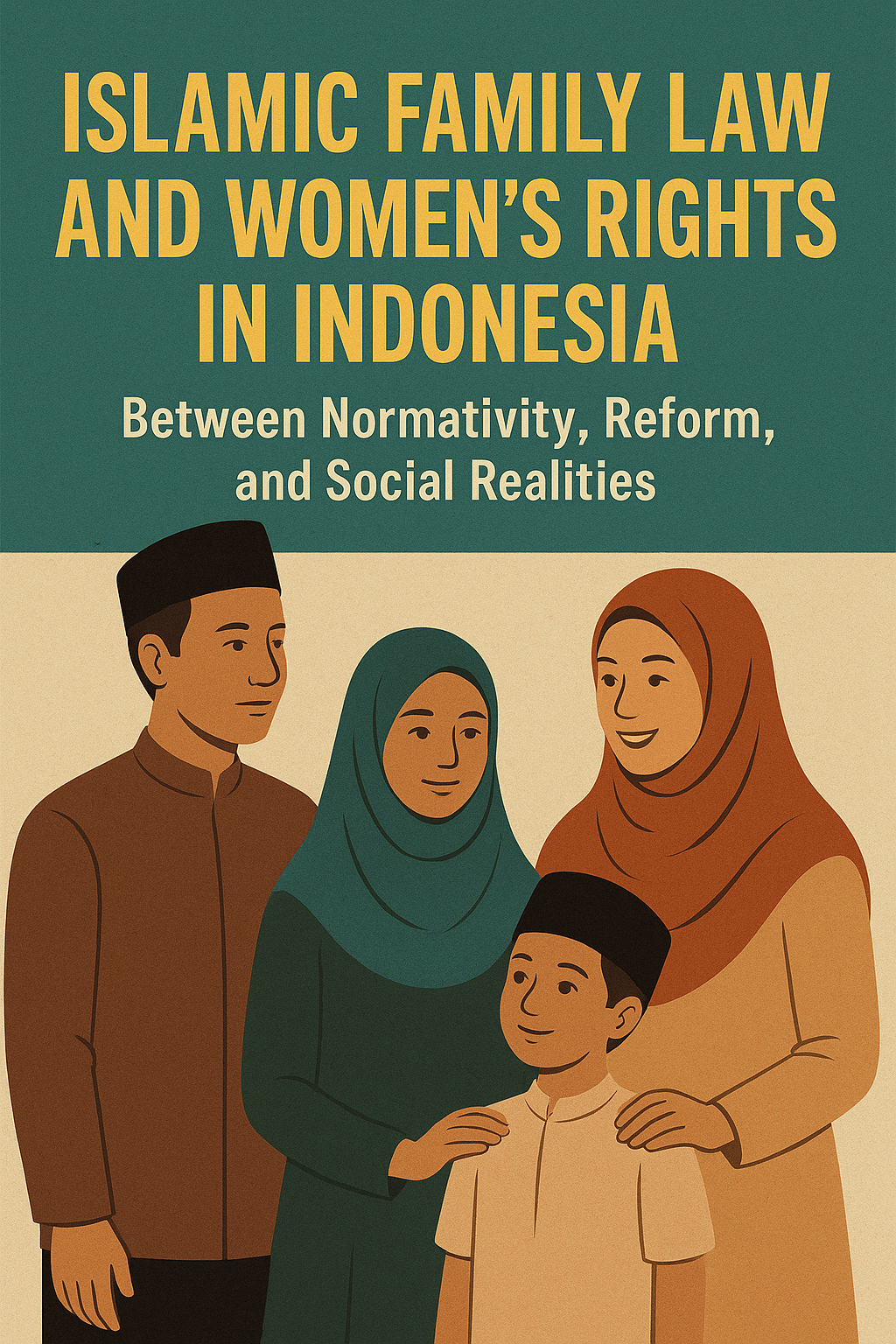
Main Article Content
Abstract
This study examines the dynamics of Islamic Family Law in Indonesia concerning women’s rights through a socio-legal analysis emphasizing the interaction between Islamic legal norms, state reform, and social realities. The research aims to identify the extent to which normative frameworks such as the Compilation of Islamic Law (KHI) continue to preserve patriarchal structures and to assess the effectiveness of legal reforms implemented through the 2019 Marriage Law amendment and progressive judicial ijtihad within the Religious Courts. The study employs a qualitative socio-legal methodology that integrates doctrinal analysis of primary legal texts (KHI and Marriage Law) with a review of academic literature, NGO reports, and empirical data related to judicial and social practices.The findings reveal a triadic tension among normativity, reform, and social realities. While the KHI still institutionalizes gender-biased provisions—such as the wali mujbir concept and the asymmetry of divorce rights—there is an emerging reformist trajectory through the standardization of marriage age and the progressive judicial interpretation that promotes women’s rights in divorce cases. Nevertheless, practices like nikah siri (unregistered marriage) and child marriage persist, reflecting a gap between legal norms and implementation. The study implies that legal reform must be complemented by social empowerment and legal literacy initiatives to ensure that gender justice in Islamic family law becomes not only a codified norm but a lived reality in Indonesian society.
Article Details

This work is licensed under a Creative Commons Attribution 4.0 International License.


References
“12 Years of Innovation in Women’s Access to the Family Courts of Indonesia | Federal Circuit and Family Court of Australia.” Accessed August 25, 2025. https://www.fcfcoa.gov.au/international/reports/12-years-womens-access-fcoi.
Afrianty, Dina. “Child Marriage: Constitutional Court Finally Ditches Religious Arguments.” Indonesia at Melbourne, n.d. Accessed August 25, 2025. https://indonesiaatmelbourne.unimelb.edu.au/child-marriage-constitutional-court-finally-ditches-religious-arguments/.
ANU Indonesia Institute. “Women’s Rights in Indonesia.” Accessed August 25, 2025. https://indonesiainstitute.anu.edu.au/content-centre/article/opinion/womens-rights-indonesia.
Asmara, Musda. “Concept Of Wali Mujbir In Marriage (Legal Criticism Of Counter Legal Draft Compilation Of Islamic Law).” JURNAL ILMIAH MIZANI: Wacana Hukum, Ekonomi, Dan Keagamaan 8, no. 2 (2021): 189. https://doi.org/10.29300/mzn.v8i2.5767.
Burhanuddin, Ahmad, Muhammadong Muhammadong, M. Bahtiar Ubaidillah, and Irwan Swandana. “Criticism of Islamic Feminism towards Patriarchy in Islamic Family Law in Indonesia.” West Science Islamic Studies 3, no. 03 (2025): 226–32. https://doi.org/10.58812/wsiss.v3i03.2066.
Erma, Zetria, and Taufika Hidayati. The Practice of Siri Marriage by Police Members Judging From the Regulation of the Chief of the Police of the Republic of Indonesia Number 6 of 2018. 11, no. 2 (2022).
Girls Not Brides. “Indonesia.” August 26, 2022. https://www.girlsnotbrides.org/learning-resources/child-marriage-atlas/regions-and-countries/indonesia/.
Halwaini, Fiqi. “Women’s Rights in the Qur’an: A Semiotic Analysis of the Practice of Family Law in Indonesia.” USRATY: Journal of Islamic Family Law 3, no. 1 (2025): 50–62.
Idary, Muhammad Tsaqib, Oyo Sunaryo Mukhlas, Beni Ahmad Saebani, and Restu Khaliq. “Plurality of Inheritance Legal System for Indonesian Muslims: A Sociological Review.” TATHO: International Journal of Islamic Thought and Sciences, November 29, 2024, 252–62. https://doi.org/10.70512/tatho.v1i4.55.
“Indonesia - Women, Business and the Law.” World Bank Group, 2023. https://wbl.worldbank.org/content/dam/documents/wbl/2023/snapshots/Indonesia.pdf.
Makruf, Solihan, Rizal Agung Mufti, Lis Diana Ningsih, Andri Suprihatno, and Beni Ahmad Saebani. “Legal Sociological Perspective on Marriage Under the Hand (Case Study Understanding of the Cipadung Community, Bandung City).” Journal of Law, Politic and Humanities 5, no. 3 (n.d.). https://doi.org/10.38035/jlph.v5i3.
Nurlaelawati, Euis, and Arskal Salim. “Gendering the Islamic Judiciary: Female Judges in the Religious Courts of Indonesia.” Al-Jami’ah: Journal of Islamic Studies 51, no. 2 (2013): 247–78.
Otto, Jan Michiel. “10 Sharia and National Law in Indonesia.” Sharia Incorporated, 2010, 433.
“Prevention of Child Marriage Acceleration That Cannot Wait.” PUSKAPA, 2020. https://www.unicef.org/indonesia/sites/unicef.org.indonesia/files/2020-06/Prevention-of-Child-Marriage-Report-2020.pdf.
Riyadi, Fuad, Ahmad Remanda, Abdurrohman Kasdi, and Arif Marsal. “Constitutional Ijtihad and the Reform of Islamic Family Law: A Comparative Analysis of Indonesia and Egypt in Advancing SDG 16.” Profetika: Jurnal Studi Islam 26, no. 02 (2025): 353–70.
Sanusi, Sanusi, Rifqi Qiwiyul Iman, Reza Baihaki, and Ibnu Farhan. “Judges’ Ijtihad on Women’s Rights after Divorce and Its Contribution to Family Law Reform in Indonesia.” SMART: Journal of Sharia, Traditon, and Modernity, 2023, 1–15.
Scribd. “Kompilasi Hukum Islam | PDF | Marriage | Wife.” Accessed August 25, 2025. https://www.scribd.com/document/526653760/Kompilasi-Hukum-Islam.
Sidiq, Muhammad Sirojudin, Andi Ali Akbar, Anggita Vela, and Muhammad Farid Zulkarnain. “Wali Al-Nikāḥ Hierarchies in Theory and Practice: Disputes, Authority, and Social Reality in Indonesian Muslim Communities.” Fikri: Jurnal Kajian Agama, Sosial Dan Budaya 10, no. 1 (2025): 397–411.
“Summary of Law of the Republic of Indonesia Number 16 Year 2019 Regarding the Amendment to Law Number 1 Year 1974 Regarding Marriage - Governmental Affairs/Organization - Legal Centric.” Accessed August 25, 2025. https://legalcentric.com/content/view/144241.
“The Republic Of Indonesia The Compilation Of Islamic Laws.” n.d. https://muslimfamilylawindex.com/wp-content/uploads/2022/12/The-Compilation-of-Islamic-Laws-No.-1-1991.pdf.
“UNICEF Welcomes Recent Amendment of Indonesia’s Marriage Act.” Accessed August 25, 2025. https://www.unicef.org/press-releases/unicef-welcomes-recent-amendment-indonesias-marriage-act.
Wahyudi, Muhammad Isna. “Women Dealing with The Law in Religious Courts.” AHKAM : Jurnal Ilmu Syariah 18, no. 2 (2018). https://doi.org/10.15408/ajis.v18i2.7491.